HGO’s powerful “Susannah” revival celebrates Carlisle Floyd centennial in style
Houston Grand Opera put the capstone on Carlisle Floyd’s career in 2016, when it premiered his Prince of Players LINK with the 89-year-old composer in attendance. That turned out to be his final work.
Five years after Floyd’s death, the company is celebrating his centennial—as well as its decades-long connection to him—by reaching back to the opera that launched his career.
Floyd was a young faculty member at Florida State University when Susannah, based loosely on the Apocryphal story of Susannah and the Elders, premiered in Tallahassee in 1955. New York City Opera staged it the very next year, and Susannah has racked up hundreds of productions across the United States and Europe.
HGO on Friday added a viscerally powerful staging to that history, one that boasts fiercely dramatic singing in the two main roles and sonorous, atmospheric playing by the HGO Orchestra.
Doubling as his own librettist, Floyd transplanted Susannah’s saga to rural Tennessee, where the local church’s elders falsely accuse the innocent teenager of being a harlot. An itinerant preacher who lands in town for a revival meeting at first calls on her to repent, then rapes her.
Floyd flavors his score with a few touches of Americana, mainly a fiddle tune that propels a church dance—simultaneously evoking J.S. Bach and Appalachia—and a quasi-folk song that Susannah sings in her despair. But his music mainly roots itself in the rich sonorities and surging melodies of late-Romantic European opera.
HGO’s opening performance Friday night made the European links even more pronounced: Susannah took on an air of Tennessee verismo.
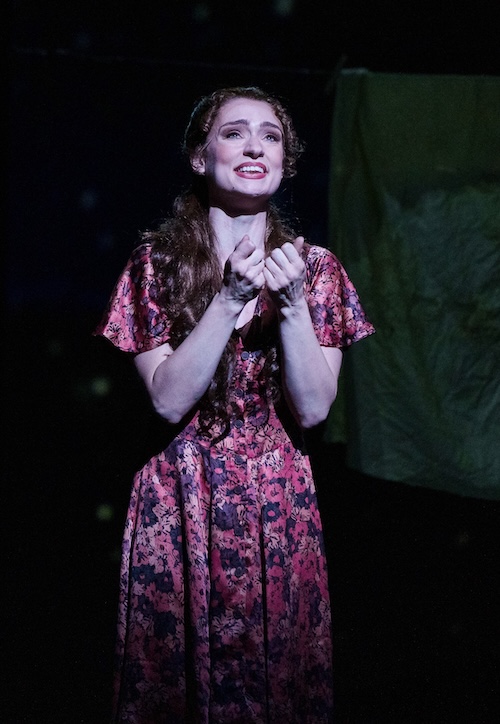
While the typical soprano cast as Susannah might treat the role to creamy, alluring tones—a la Renee Fleming, who played the beleaguered girl at the Metropolitan Opera—Sylvia D’Eramo brought a voice with a more narrowly focused sound.
Amid the gentle lyricism of Susannah’s first aria, “Ain’t it a pretty night,” D’Eramo’s bright, lean tone created less a nocturnal idyll than a glimpse of Susannah’s restlessness to see the world beyond New Hope Valley. When the vocal line suddenly vaulted skyward, though, D’Eramo switched to a pianissimo that added a dash of otherworldliness.
As Susannah suffered the torments of the town’s condemnation, D’Eramo’s voice welled up in pungent, penetrating tones of a sort that might suit many a beleaguered Italian-opera heroine. Even in the more meditative “The trees on the mountain,” D’Eramo’s plaintive sound injected urgency into the folklike melody.
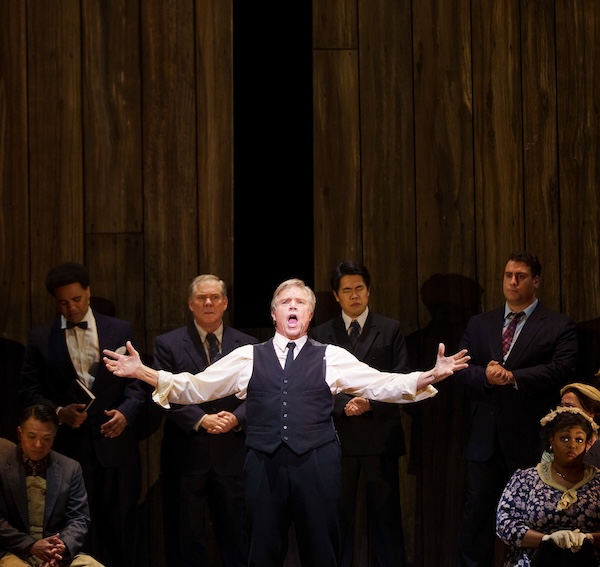
Bass-baritone Rod Gilfry made Blitch just as formidable in his individual way. Floyd filled the role with all the histrionics of a fire-and-brimstone preacher, from simple spoken words to all-out thunderings, and Gilfry played it to the hilt.
Much as he did as the villainous Scarpia in HGO’s 2023 Tosca, LINK Gilfry ran the gamut of vocal theatrics. His Blitch spoke to the revival congregation in calm, beseeching tones as readily as he bellowed and boomed.
When Blitch lamented his loneliness as a traveling preacher—the prelude to his assaulting Susannah—Gilfry’s voice took on a broken, weary sound that belied Blitch’s abusive urges. But when Blitch was overtaken by remorse, Gilfry again pulled out all the vocal stops. Fatigue or forcing his voice may have contributed to some rawness Friday, but that just added to the realistic effect.
Tenor Bille Bruley, playing Susannah’s brother, Sam, sang with a clarity and ring that let him relish the humor of the “Jaybird Song,” as well as bringing out the sadness of Sam’s meditation on mean-spirited people. Tenor Aaron Blake lent an air of nervousness and pathos to Little Bat, the youngster who betrays Susannah.
HGO cast a lusty-voiced group to play to church leaders who gang up on Susannah.
Mezzo-soprano Deborah Nansteel brought particular gusto to the role of Mrs. McLean, who is something of a ringleader, and mezzo-soprano Leia Lensing and sopranos Scarlett Jones and Elizabeth Hanje chimed right in. As the church elders, baritone Malcolm McKenzie, bass Ziniu Zhao and tenors Martin Luther Clark and Luka Tsevelidze were just as spirited.
James Gaffigan, HGO’s music designate, led the HGO Orchestra in a performance to savor the variety of Floyd’s score, from starry-night serenity and country-dance bounciness to surges of ardent melody and bursts of sonic menace. The HGO Chorus sang with fervor in the revival scenes.
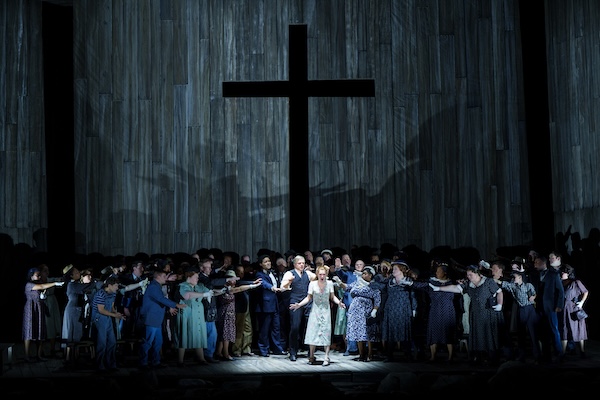
Soprano-turned-stage-director Patricia Racette brought particular force to the scenes of the church people attacking Susanna. In the dance, for instance, the bulk of the crowd froze in place as Susannah danced in slow motion in a spotlight, and the women gazed at her and tut-tutted.
Designer Erhard Rom’s video projections during the prelude and interludes helped set scenes, and the shots of towering barn walls at the very beginning established a tone of claustrophobia and danger. The towering-wall motif carried over into Rom’s stage set, which combined stationary panels flanking the stage with smaller sections that flew in and out to evoke the church or Susannah’s house. Both ingredients enhanced the opera’s fast pace and theatrical wallop.
Along with last spring’s revival of Floyd’s Of Mice and Men by HGO’s Butler Studio training program, this staging of Susannah marks the half-century point in the symbiotic relationship between company and composer.
Floyd took a professorship at the University of Houston in 1976, and he promptly joined forces with HGO. He co-founded the training program, and the company premiered five of his operas—including Willie Stark, based on Robert Penn Warren’s All the King’s Men.
Floyd has passed, but Susannah shows that his music and HGO’s side of the collaboration live on.
Susannah runs through November 8 at Wortham Theater Center. houstongrandopera.org
Leave a Comment