Fine singing wins out over baffling production conceits in HGO’s “Faust”
Opera houses in German-speaking lands long referred to Charles Gounod’s most famous work as Marguerite after its heroine’s name rather than the official title. They didn’t want to equate the opera with the iconic play that inspired it: Goethe’s Faust.
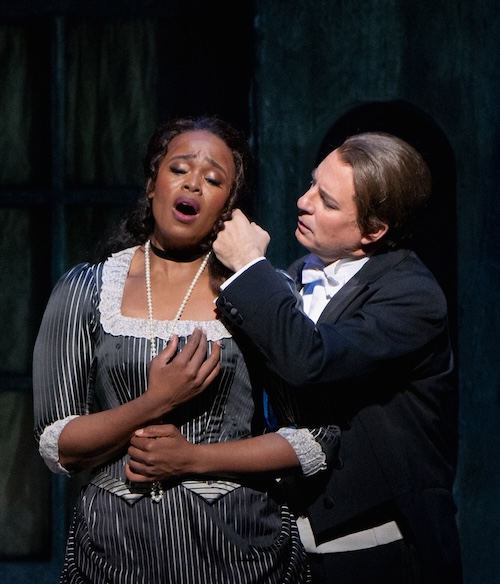
The Marguerite title would suit Houston Grand Opera’s production, which opened Friday at Wortham Theater Center. For all the flamboyance of the male protagonists’ singing—and the flashiness of David McVicar’s staging, which transplants the story to Gounod’s late-1800s Paris milieu—soprano Pretty Yende’s Marguerite was easily the most compelling figure.
No, she didn’t match the raw, visceral impact that Matthew Polenzani’s Faust and John Relyea’s Mephistopheles gave Gounod’s music. But amid the soaring melodies of the Church Scene and final trio, Yende’s vibrant and free vocalism surged to the fore, leading the music’s lyrical payoff.
Yende, making her HGO debut, put across Marguerite’s sweetness and suffering through a vocal palette that embraced both gleam and glow, as well as evocative half-shades and the occasional dramatic sharpness.
After Marguerite’s first encounter with Faust, Yende brought the young girl’s stirrings of emotion to life by setting the veiled, introspective tone of the King of Thule story against the flicker of excitement in her recollections of the noble-looking stranger.
Yende’s Jewel Song was airy and lilting, its flourishes tossed off lightly. Yet when Marguerite thought back to her deceased younger sister, Yende sang with such tenderness that the brief episode registered nearly as powerfully as a full-fledged aria. And in the love duet with Faust, Yende treated Gounod’s melodies to a warmth and grace that offered the last glimpses of Marguerite’s innocence.
Polenzani’s Faust was full-throated and ringing from the start. The tenor’s singing drove home the elderly Faust’s frustration with the world and the transformed philosopher’s ardor. When Mephistopheles conjured up legendary courtesans, Polenzani gave Faust’s drinking song a devil-may-care—so to speak—swagger.
Yet Polenzani didn’t deal in forcefulness alone. At the climax of Faust’s big aria, “Salut! Demeure chaste et pure,” Polenzani scaled his voice down to a whisper, and he brought gentle turns to the love duet, too.
At lower dynamics Polenzani’s voice sometimes sounded wan. In the love duet, the contrast with Yende’s fluent, graceful singing was palpable.
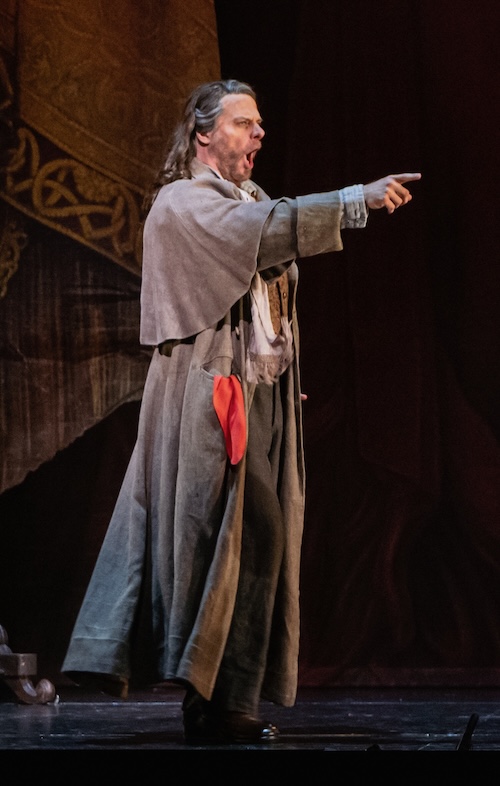
As Mephistopheles, the plot’s satanic driving force, bass-baritone Relyea—also making his HGO debut—unleashed volleys of voluminous, sepulchral tone.
In the first scene or two, Relyea tended to underplay the wryness and cajoling of Mephistopheles’ banter with Faust. But Relyea’s singing became more varied and colorful as the night progressed. The big moments of the Golden Calf aria boomed, and the parts in between were biting and raucous. The Serenade had an apt sarcastic edge. And in the Church Scene, Mephistopheles’ condemnations of Marguerite burst forth like thunderbolts.
As the other character who curses Marguerite—Valentin, her brother—baritone Sean Michael Plumb didn’t need to be as larger-than-life. But his voice was generous, round and resonant. In Valentin’s famous entrance aria, “Avant de quitter ces lieux,” Plumb sang so resolutely that the music came across as more grandiose than affectionate.
Mezzo-soprano Sun-Ly Pierce sang with vivacity and luster in the role of Siebel, a youth who is devoted to Marguerite. Mezzo-soprano Deborah Nansteel relished the lustiness of Marguerite’s neighbor Marthe. And bass-baritone Sam Dhobhany sang heartily as the soldier Wagner.
The men of the HGO Chorus filled the Soldier’s Chorus with vitality, jauntiness and red-blooded spirit. And with the women joining in, the famous waltz was breezy and jovial.
Conductor Giacomo Sagripanti, in his company debut, brought out the score’s theatricality and sweep while making room for the singers to savor lyrical moments. He also led the HGO Orchestra to play with weight, fire and lyrical poise.
Meanwhile, McVicar’s production—handled in this revival by director Peter Relton—transported the action to Paris. That certainly set up a panoply of new stage business, with Faust now portrayed as a composer.
Brigitte Reiffenstuel’s minimalist set consisted mainly of a stylized street scene weaving together Marguerite’s house, the interior of a Gothic church—including the organ loft—and a theater box. During the Church Scene, which includes a prominent organ part, Faust himself was positioned at the console, and dancers portraying Mephistopheles’ henchmen helped torment Marguerite.
Part of Act 2 unfolded in a Moulin Rouge-style nightspot with the name Cabaret L’Enfer emblazoned in lights. Marguerite worked there as a serving maid, and dancing girls entertained the crowd during the waltz.
At the big finish, after Marguerite swooned, the focus turned to the organ loft, where a grizzled old fellow with white angel wings affixed to his back stepped forth. Did he represent Gounod, perhaps?
Whatever the finish meant, it turned the attention away from Marguerite and her redemption—which was a particular pity in this case, after Yende had been so powerful.
Faust runs through Nov. 15 at Wortham Theater Center. houstongrandopera.org
Leave a Comment