Serene music frames de la Salle’s riveting Rachmaninoff with Luisi, DSO
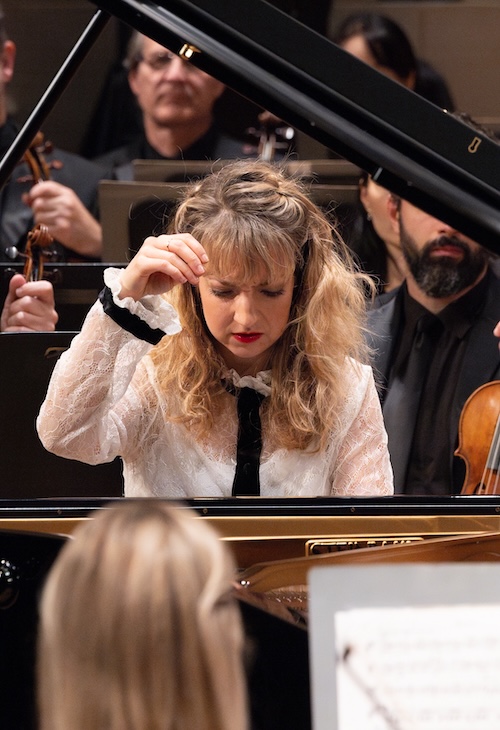
Fabio Luisi and the Dallas Symphony Orchestra welcomed pianist Lise de la Salle to the Morton Meyerson Symphony Center Friday for a fiery performance of Sergei Rachmaninoff’s Piano Concerto No. 1. The program also included the Symphony No. 2 by Alan Hovhaness and Franz Schubert’s “Unfinished” symphony/
The inspiration for the subtitle of Hovhaness’s symphony, “Mysterious Mountain,” was instantly apparent from the serene and resplendent chords over softly undulating timpani that opened the piece. Luisi gently indicated a moderate yet steady tempo as the strings and winds traded richly voiced modal mantras, interrupted briefly by meditations from Willa Henigman’s oboe and Gregory Raden’s clarinet.
The second movement saw the strings take up a series of fugues on a pentatonic melody as Luisi channeled the diverse melodic lines into a hypnotic texture that increased in tempo and intensity, forming a sonic bed for a somber brass chorale that brought the movement to a close.
Muted trombones announced the third movement with an austere, hymn-like song recalling the mystical aura of the first movement, after which Luisi cued the strings and subtle timpani rolls to fill out the sonority. Slowly and deliberately, the orchestra intoned the hymn until the movement’s end, diminishing briefly as if taking a breath before concluding at Luisi’s indication in a broad and majestic cadence.
Throughout the Rachmaninoff concerto, piano soloist Lise de la Salle dazzled with her performance. Her fingers were in almost constant motion, usually rapid. Even the slower, more lyrical passages were marked by a palpable intensity and dynamism. Her instrument maintained a clear, rich and varied tone, and the pianist produced effervescent arpeggios in the upper octaves and thundering chords in the bass register.
Right from the orchestra’s bold opening statement, to which de la Salle made her own furious response, the DSO under Luisi matched her every gesture, launching into the first movement’s principal theme, shadowing de la Salle’s lead as she helmed the transition, and dividing into string and wind camps to confront her with the secondary theme. In the first movement’s cadenza, the pianist’s bravura scales and ardent chords were tempered by a moment of passionate lyricism before she was joined by the orchestra in a race to the movement’s conclusion.
The second movement brought a change of tempo and mood that was still marked by an underlying fervor that grew more apparent as a pair of bassoons joined de la Salle’s delicate nocturne then buoyed by the rich DSO strings.
The headlong tempo of the finale imbued that movement with the character of a scherzo as the piano and orchestra engaged in rapid-fire exchanges of brisk melodic fragments. Even the lyrical middle section, recalling the similar passage from the first movement’s cadenza, was marked by brilliant execution from de la Salle.
As an encore, de la Salle performed a piano arrangement of J. S. Bach’s chorale prelude, “Ich ruf zu dir, Herr Jesu Christ,” describing her selection as a personal response to current events.
For the second half of the program, the compact “Unfinished” by Schubert at first appeared potentially anticlimactic in the wake of the dynamic concerto performance. Despite the mood of uneasiness that characterizes the first movement’s introductory motif, the DSO’s initial performance of the exposition seemed a bit reserved and polite.
In the exposition’s reprise, however, Luisi coaxed noticeably more expression out of the ensemble, prompting a little more pathos from the forlorn clarinet melody, a little more urgency from the string accompaniment, and more power to the first climax, trends that he maintained throughout the duration of the movement that enhanced the score’s gravitas.
In the slow movement, the conductor directed the horns and winds to lean into the calm, pastoral character of their respective parts while urging the entire ensemble to enhance the plaintive quality of the contrasting second theme before returning to the serene and bucolic opening material for a settled and satisfactory conclusion to the symphony and to the evening’s program.
The program will be repeated 7:30 p.m. Saturday. dallassymphony.org
Leave a Comment