DSO mixes an offbeat triple concerto with rousing Rachmaninoff
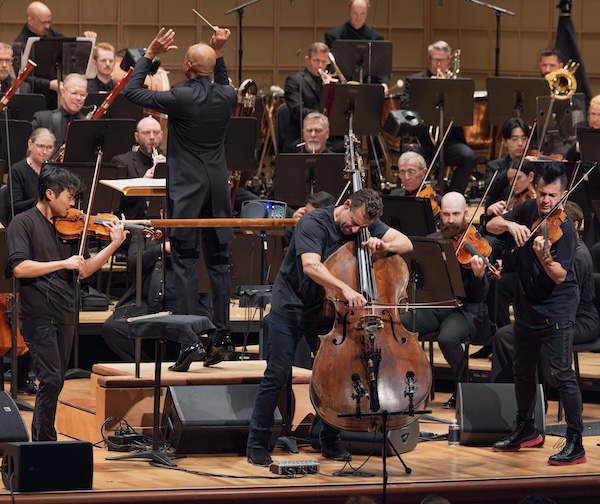
The Dallas Symphony Orchestra and guest conductor Kevin John Edusei welcomed the eclectic string trio Time for Three Friday night for the Dallas premiere of Contact, a Grammy-Award winning work by Kevin Puts. Edusei closed the evening by leading the DSO in a stirring performance of Sergei Rachmaninoff’s Symphony No. 2.
Consisting of violinists Nicolas Kendall and Charles Yang and double bassist Ranaan Meyer, Time for Three defies easy categorization, blending features of folk, classical and popular music styles in performances often marked by improvisation and even singing by the three members.
Although the initial premiere of Contact was delayed due to the Covid pandemic, composer Kevin Puts described this as an unexpected “silver lining,” allowing further refinement of the piece in collaboration with the trio that underlined the music’s “resonance during [those] years of isolation,” and prompting the title, which marks the triple concerto as “an expression of yearning for this fundamental human need.”
Time for Three cuts a visual impression as striking as that of their playing; Meyer was flanked by Yang and Kendall on either side, with each member coiled in an alert stance as if poised to spring into action.
True to the trio’s unorthodox nature, the first movement, (“The Call”) began with wordless vocals from all three members as they sang an a cappella chord sequence that was softly echoed and taken up by the orchestra. The trio soon began embellishing the sequence instrumentally with arpeggios and rhythmic figures that were adopted by the orchestra, establishing a pattern of alternation between the trio and the ensemble before concluding with the a cappella vocal sequence that began the movement.
The first movement had scarcely faded into silence when a series of jarring outbursts from the full orchestra triggered a frenetic rhythmic passage from the trio, with Kendall executing rapid figurations on his violin as Yang fiercely strummed his, all over a running bass line provided by Meyer. Throughout this second movement (“The Code”) various instrumental groups doubled the activity of the trio in short bursts, punctuated intermittently by the percussion.
Austere chords from the strings and winds opened the third movement, itself titled “Contact,” and were answered by an undulating passage from the soloists underscoring a lyrical dialogue between Willa Henigman’s oboe and Paul Hafley’s clarinet.
Puts based the finale, “Convivium,” on a Bulgarian dance tune having a rollicking, asymmetrical rhythm that served as a recurring refrain for the soloists, linking a series of boisterous episodes in the festive movement and alluding to the eventual development of contact into community, with its accompanying liveliness and vivacity.
Notably, all three were constantly playing, with each member complementing, reinforcing or accompanying the other two; there never appeared to be an instance in which one member played alone.
Edusei’s presence was felt in the tight rhythmic coordination between the orchestra and the trio and in the seamless matching of character between the larger ensemble and the soloists.
The positive response from the audience guaranteed an encore, but the nature of that encore was something of a surprise even if it was consistent with the group’s eclecticism. While Yang strummed an ostinato on his violin, Kendall and Meyer provided some brief quotations of Dueling Banjos and Ode to Joy before settling into a rendition of “Can’t Take My Eyes Off of You,” with Yang singing lead and (successfully) encouraging members of the audience to sing along.
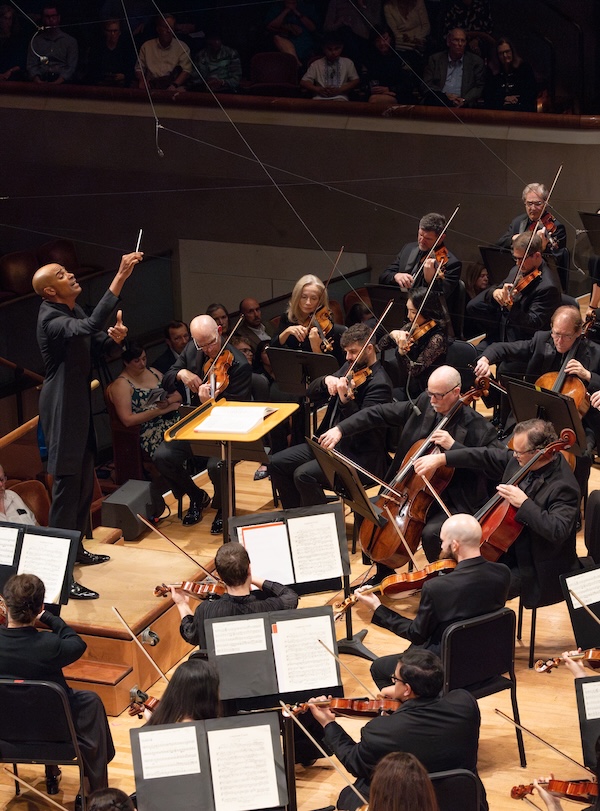
The second half of the program gave Edusei more prominence as he led the DSO in the resplendent Second Symphony of Sergei Rachmaninoff. With its sweeping, soaring string melodies, clipped martial passages and lyrical wind interludes, Rachmaninoff’s symphony is an exemplar of musical romanticism in the Russian manner that could easily become maudlin if carelessly conducted.
Edusei’s deft management of all these gestures struck a carefully controlled balance between taste and expression that preserved and enhanced the emotional impact of the piece.
The conductor coaxed smooth, graceful phrases from solo winds, especially as heard from Gregory Baden’s clarinet in the Adagio, as well as crisp, precise articulation from the brass and percussion during the march episodes of the second and fourth movements. Edusei’s meticulous shaping of the soaring dynamic swells from the strings in all the movements added up to a truly powerful performance of the symphony from the DSO and a thrilling conclusion to the evening.
The program will be repeated 7:30 p.m. Saturday and 2 p.m. Sunday. dallassymphony.org
Leave a Comment