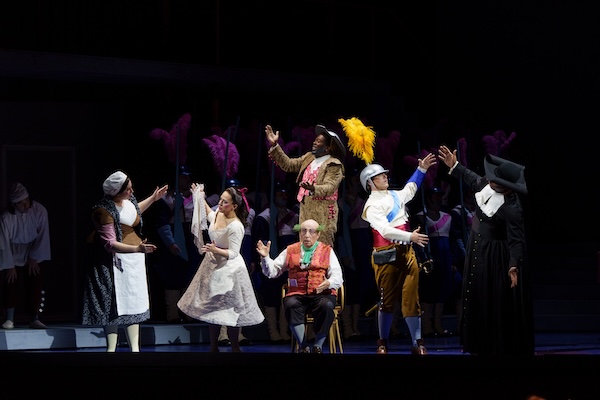
Tenor Swanson shines brightly in HGO’s mostly enjoyable “Barber”
Call this the springtime of the workhorse tenors at Houston Grand Opera.
First, Ben Bliss took on the tenor part in Mozart’s arrangement of Handel’s Messiah—which shifts the soprano’s florid “Rejoice greatly” to the tenor—as if he didn’t have enough to do—and dispatched the expanded role’s lyricism, exuberance and forcefulness with flair.
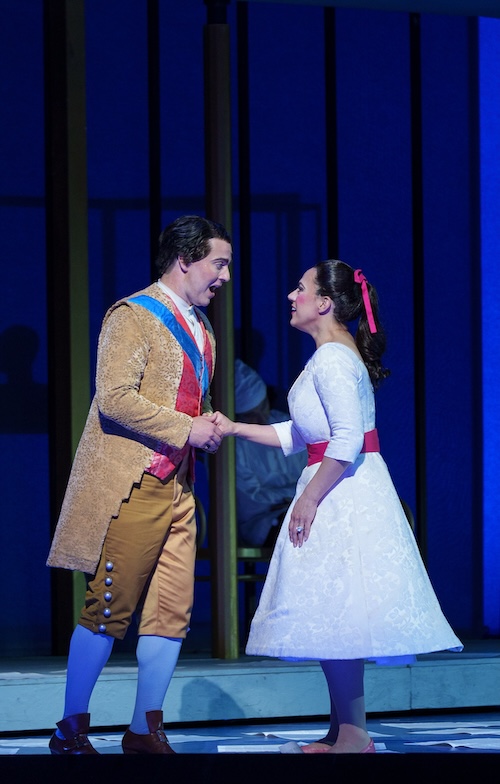
Now, Rossini’s The Barber of Seville puts Jack Swanson in the hot seat.
He plays Count Almaviva, whose passion for the high-spirited Rosina propels Rossini’s beloved opera buffa. After two long acts full of vocal acrobatics and comic hijinks, HGO calls on Swanson to add a climactic burst of gymnastics in the form of a long-neglected aria: “Cessa di più resistere,” for a concluding showpiece.
Three hours into Sunday’s performance at Wortham Theater Center, Swanson still sang with the vigor, assurance and brilliant tone he had brought Rossini all afternoon. The aria is practically a little scene unto itself, nailing down the opera’s resolution, and Swanson delivered it with a flourish.
In the first part, Almaviva tells Dr. Bartolo, Rosina’s guardian, to give up his scheme to marry her, and Swanson laid down the law in ringing, decisive terms. Swanson’s Almaviva then produced a surge of ardent lyricism to promise Rosina that she would at last have a loving husband. And in the burst of coloratura that lets Almvaviva’s own excitement bubble over, Swanson let loose with some of his most agile singing of the day.
Swanson had practically opened the opera with Almaviva’s entrance aria, “Ecco, ridente,” and his gleaming tones were already putting across Almaviva’s passion–even if his voice still needed a little warming-up with the filigree. As the story unfolded, Swanson captured Almaviva’s ardor for Rosina as readily as his mirth in plotting against deluded old Bartolo.
Besides singing with flair, Swanson threw himself into the story’s comic masquerades—staggering through Bartolo’s door when Almaviva pretended to be a tipsy soldier, then swirling rapturously around the stage to cosplay a nasal-voiced music teacher.
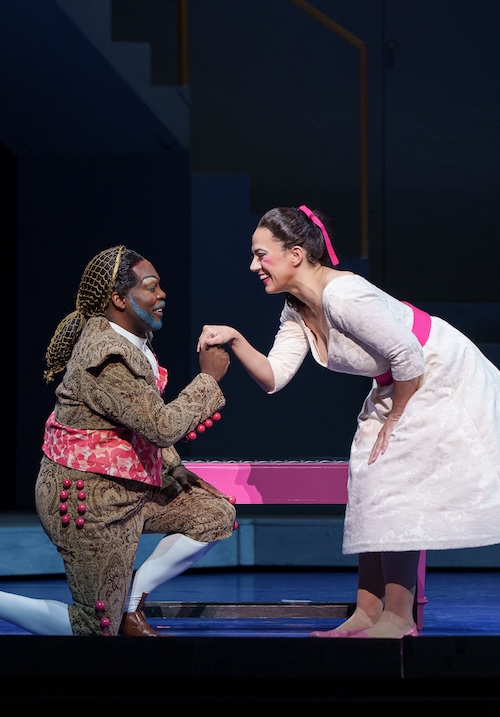
As Figaro, the quick-witted barber who devises the schemes that pry Rosina away from Bartolo, baritone Will Liverman was a bundle of energy—thanks to his dynamic singing and buoyant demeanor alike. Figaro’s celebrated entrance aria, “Largo al factotum,” exuded joviality, thanks to Liverman’s dynamism, vibrant tone and freewheeling imitations of Figaro’s clients’ outcries.
Liverman’s Figaro remained just as animated throughout the story’s twists and turns.
In the duets with Almaviva and Rosina that help set off the opera’s schemes, Liverman tossed off his end of the repartee colorfully, and he swept through the occasional burst of coloratura with vigor enough to get the excitement across. And in the final scene, as Figaro tried to keep the lovers moving to avoid calamity, Liverman echoed Swanson’s Almaviva with comic gusto.
Mezzo-soprano Daniela Mack kept Rosina’s free spirit and rebelliousness in the forefront. Mack’s voice was full-bodied and rich, with hints of contralto depth. So she was well equipped to put across the spitfire element in Rosina’s music, beginning with her aria, “Una voce poco fa” and on through the ups and downs the lovers confront.
Mack’s coloratura was sometimes vague and high notes sounded pushed, but Rosina’s spunkiness always came through. And Mack gave hints of a gentler touch to “Contro un cor,” the more lyrical aria in Act 2’s mock music lesson.
Veteran baritone Alessandro Corbelli filled Bartolo with life. Whether the old man was dumbfounded by the events around him or raging about them, Corbelli sang with theatricality and gusto. And when it came to comic pizazz, Corbelli and Swanson clicked during Almaviva’s masquerades as the soldier and cosplaying a nasal-voiced music teacher.
Playing Rosina’s music teacher, Don Basilio, bass-baritone Ryan Speedo Green boasted a dark, voluminous voice tailor-made for the walloping crescendos of “La calunnia,” Basilio’s tribute to scheming and slander. When the aria invoked cannon shots, Green had the goods to drive home the point.
Amid the supporting roles, soprano Alissa Goretsky sang lustily in the chambermaid Berta’s aria. As Almaviva’s servant, Fiorello, baritone Geonho Lee brought his moments a poise that befitted a gentleman’s gentleman.
Conductor Gemma New led a fleet, breezy performance, keeping the comic momentum alive. During the famous Overture, the HGO Orchestra’s winds sometimes drowned out the strings, cancelling out some of Rossini’s bustle. But the orchestral byplay was better sorted-out during the opera proper.
New occasionally eased back the tempo a bit to help a singer handle Rossini’s acrobatics, but without sacrificing the overall flow. Meanwhile, men from the HGO Chorus at times chimed in with the general vitality.
All this unfolded in director Joan Font’s production, which HGO first presented in 2018. Font’s staging certainly delivered a lively group of central characters, and Joan Guillén’s sets and costumes added color and whimsy.
As in 2018, Font included all manner of byplay by supernumeraries—playing Bartolo’s servants and others—that occasionally competed with the principals for attention. During “La calunnia,” for instance, the servants engaged in a long setup for a sight gag. It not only pulled the focus away from Green, but it did so for a payoff that anyone could see coming.
The Barber of Seville runs through May 10. houstongrandopera.org