Luisi, Dallas Symphony bring grandeur and grit to Bruckner’s swan song
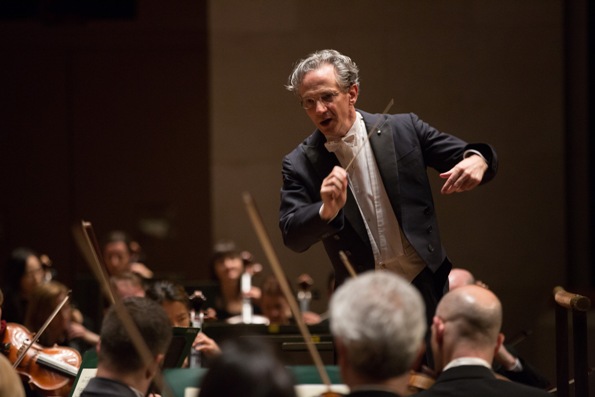
The Meyerson Symphony Center resounded Thursday night with the strains of Bruckner’s Ninth Symphony in a resplendent performance by Fabio Luisi and the Dallas Symphony Orchestra. Bruckner’s symphony is the latest in the DSO’s exploration of Austro-German symphonic masterpieces that includes Bruckner’s Seventh and Mahler’s Second last season, Mahler’s Fourth in October, and that anticipates their presentation of Mahler’s Eighth in May.
Because the finale of his Ninth Symphony remained incomplete upon Bruckner’s death, performances of the three extant movements follow a unique succession of slow, fast and slow tempos, with the Adagio providing the conclusion to the symphony. Nevertheless, those movements address profound existential ideas using an expansive range of sounds and textures requiring a full contingent of strings and winds and an enlarged brass section featuring eight horns, four of which double on Wagner tubas.
The daunting power of that enhanced brass section was on full display right from the onset. Following a muted introduction to the first movement, the brass took control, sounding a colossal and prodigious dirge in unison as Luisi resolutely guided them through the first theme group. The collective brass instruments similarly dominated the scherzo portions of the second movement, hammering inexorably at a unison figure under Luisi’s relentless direction. Only in the Adagio, where the combined brass buttressed a series of brief crescendo passages, did they shed this pessimistic character in favor of a more propitious spirit.
The strings served as a principal foil to the collective force of the brass, introducing contrasting themes and passages with similarly contrasting moods that mitigated the energy and stoic fatalism of the brass dirges. The first movement’s second theme was one such instance as Luisi, following a pause by the brass, gently prompted a yearning melody from the violins supported by complementary figures from the violas and cellos, all buoyed by soft chords from the horns.
The trio of the Scherzo saw the strings offering another respite from the insistent brass. It began with a scurrying melody from the violins underscored by a sequence of delicately reiterated chords in the lower strings and gained momentum as it proceeded, punctuated at various points by winds and eventually joined by trumpets and horns. Despite its accumulated activity, the trio maintained its light and fleeting character under Luisi’s direction, intensifying its contrast with the scherzo proper.
The Dallas winds supplemented the other groups colorfully and rhythmically, augmenting the pensive strings and vigorous brass with unison accompaniments or complementary figures and occasionally coming to the fore to provide brief moments of calm during which the brass and strings subsided. Interwoven throughout were fine solo passages from each of the wind principals: flutist David Buck, oboe Mark Debski, clarinetist from Gregory Raden and solo horn Daniel Hawkins.
The strings assumed a new prominence in the Adagio, which commenced with an impassioned melody marked by a rising ninth from the violins that set in motion a gradual but brief crescendo from the entire orchestra. This process repeated as Luisi led the ensemble through a series of similar themes from the violins, each of which brought on a similar crescendo that receded once it reached its apex.
The sense of anticipation created by the successive crescendos appeared to be building toward a climactic apotheosis, but the crescendos always softened, each cycle returning to an increasingly serene and tranquil starting point with the strings. Of course, listeners would ultimately remember that they were hearing the “slow” movement of the symphony and that consequently, the movement’s end, and by extension the symphony’s conclusion, would be marked not by a triumphant resolution but by a contemplative finish.
The program will be repeated Friday at 7:30 pm. dallassymphony.org
Leave a Comment